
ADAS Windshield Calibration and Safe Glass Choices for Fallston, MD Drivers
Jones Body Shop & Collision Center - ADAS Windshield Calibration and Safe Glass Choices for Fallston, MD Drivers
Your windshield frames the road and hosts some of the most important safety hardware on your vehicle. When you service that glass, the choices you make — from the type of windshield to how cameras are recalibrated — directly affect how confidently your car can warn, guide, and protect you. In a town of quick turns, school zones, and rural connectors, getting ADAS and optics right matters on every trip.
Let’s break down what happens during post-glass calibration, why the right windshield spec matters, and how a methodical process reduces comebacks, false alerts, and driver frustration. If you have ever seen a lane-keep warning flash at the wrong moment or cruise control refuse to set, chances are alignment or glass spec is the root cause.
Why Calibration Matters After Windshield Service
Front-facing cameras look through a fixed window in your windshield. Replace or disturb that window — even slightly — and the camera’s aim changes. Calibration re-teaches the system where lane lines, horizon points, and target distances should be. Static calibration aligns the camera to precisely placed targets at known distances; dynamic calibration validates those corrections on the road at specific speeds. Skip either step and your car can misread lane edges, trigger phantom braking, or ignore genuine hazards.
Because calibration relies on careful measurements, a controlled environment is best: level floors, consistent lighting, and exact target placement. That is how you avoid small angle errors that balloon into big on-road surprises.
Glass Choices: OEM, OEM-equivalent, and What Changes
- Bracket and frit accuracy: Camera brackets and black ceramic frit patterns must match factory placement to prevent glare and misalignment.
- Optical clarity and tint: HUD, rain sensors, and acoustic interlayers require specific clarity, color, and sound-damping to work properly.
- Heated and coated zones: Wiper de-ice areas, antenna traces, and hydrophobic coatings need correct power and coverage zones.
- Edge thickness and bow: Variations in thickness or curvature can shift how the camera sees the horizon and lane markers.
Choosing a windshield that preserves these attributes protects your tech and your view. A mismatched bracket or tint might seem minor, but it can force aggressive calibration offsets or leave the system outside acceptable tolerances.
Our Proven Calibration Workflow
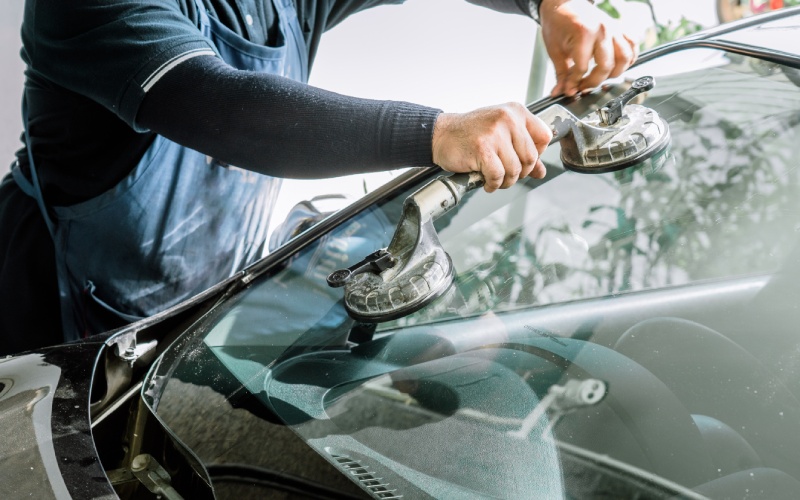
A disciplined process reduces risk and speeds your return to the road. We begin with a pre-scan to capture current codes and verify sensor health. After removing trims and the old glass without scuffing paint or tearing moldings, we set the new windshield with manufacturer-approved urethane and observe safe-drive-away times based on temperature and humidity. Then we perform static target alignment, dynamic road validation, and a post-scan to confirm clean reports across camera, radar, and rain sensors.
- Pre-scan and inspection: Verify camera, rain sensor, and HUD readiness before glass work begins.
- Precision set: Dry-fit, measure, and bond with approved urethane, observing cure windows.
- Static calibration: Align to targets at specified distances, heights, and lighting.
- Dynamic validation: Road-test at defined speeds to confirm line tracking and sign recognition.
- Post-scan and documentation: Clear codes, capture reports, and return the vehicle with a clean bill of health.
Local routes around Fallston include undulating two-lane stretches where deer, farm equipment, and sharp shadows test camera logic. That makes accurate horizon mapping and lane recognition essential, especially at dusk when glare and contrast changes challenge optics.
What Drivers Notice When Calibration Is Off
- Phantom alerts: Lane-departure or forward-collision warnings trigger with no clear reason.
- Feature dropouts: Adaptive cruise or lane centering refuses to engage or disengages unexpectedly.
- Steering nudges: Lane-keep assistance tugs at the wrong moment or biases toward one side.
- Glare and distortion: Persistent halos from pitting or the wrong tint increase night strain.
If any of these symptoms appear after glass work, stop by for an evaluation. Often, a calibration refresh or a sensor reseat resolves the complaint. In other cases, the windshield specification itself is the culprit, and matching the correct bracket, frit, and coating restores proper function.
Frequently Asked Questions:
Do I always need calibration after windshield replacement?
Most late-model vehicles with cameras or sensors behind the glass require calibration after any windshield replacement. It is essential for accurate lane, sign, and vehicle detection.
Can I drive immediately after new glass is installed?
Adhesive cure times vary with temperature and humidity. We will advise a safe-drive-away window and complete calibrations before returning your keys.
What if my warning lights are off — do I still need calibration?
Yes. Many systems will not set a fault for minor misalignment, yet performance can still be outside tolerance. Calibration brings it back to spec.
Is mobile calibration as accurate as in-shop?
In-shop calibration offers controlled lighting, level floors, and precise target distances — the best conditions for repeatable, accurate results.
How do potholes and gravel affect my glass and sensors?
Impacts can chip glass and jolt camera mounts. Early chip repair and periodic inspection keep optics clear and alignment steady.
When it comes to windshields, precision is safety. From correct glass selection to ADAS calibration, thoughtful steps protect your view and your vehicle’s most advanced features. At the end of the day, you should drive away with a windshield that looks invisible and tech that simply works. That is our goal on every job at Jones Body Shop & Collision Center, serving Baltimore, Fallston, and Bel Air with training, tools, and a calibration process built for today’s vehicles.